Selecting Materials for a Walk-In Closet That Lasts 30 Years
Material Choices That Determine Whether a Closet Survives Three Decades
A luxury walk-in closet should outlast at least two renovation cycles in the surrounding rooms. That means 25-30 years of daily use — doors opening and closing 4-6 times per day, drawers cycling 2-3 times daily, shelves bearing 15-40kg of folded garments continuously. The materials chosen during design determine whether the closet holds up to this use pattern or begins degrading within the first decade.
This is a materials engineering guide, covering panel substrates, wood species for specific applications, drawer and hinge mechanisms, interior linings, glass options, and hardware finishes — with specific product references and durability data where available.
Panel Substrates: Solid Wood vs Veneered MDF vs Lacquered Board
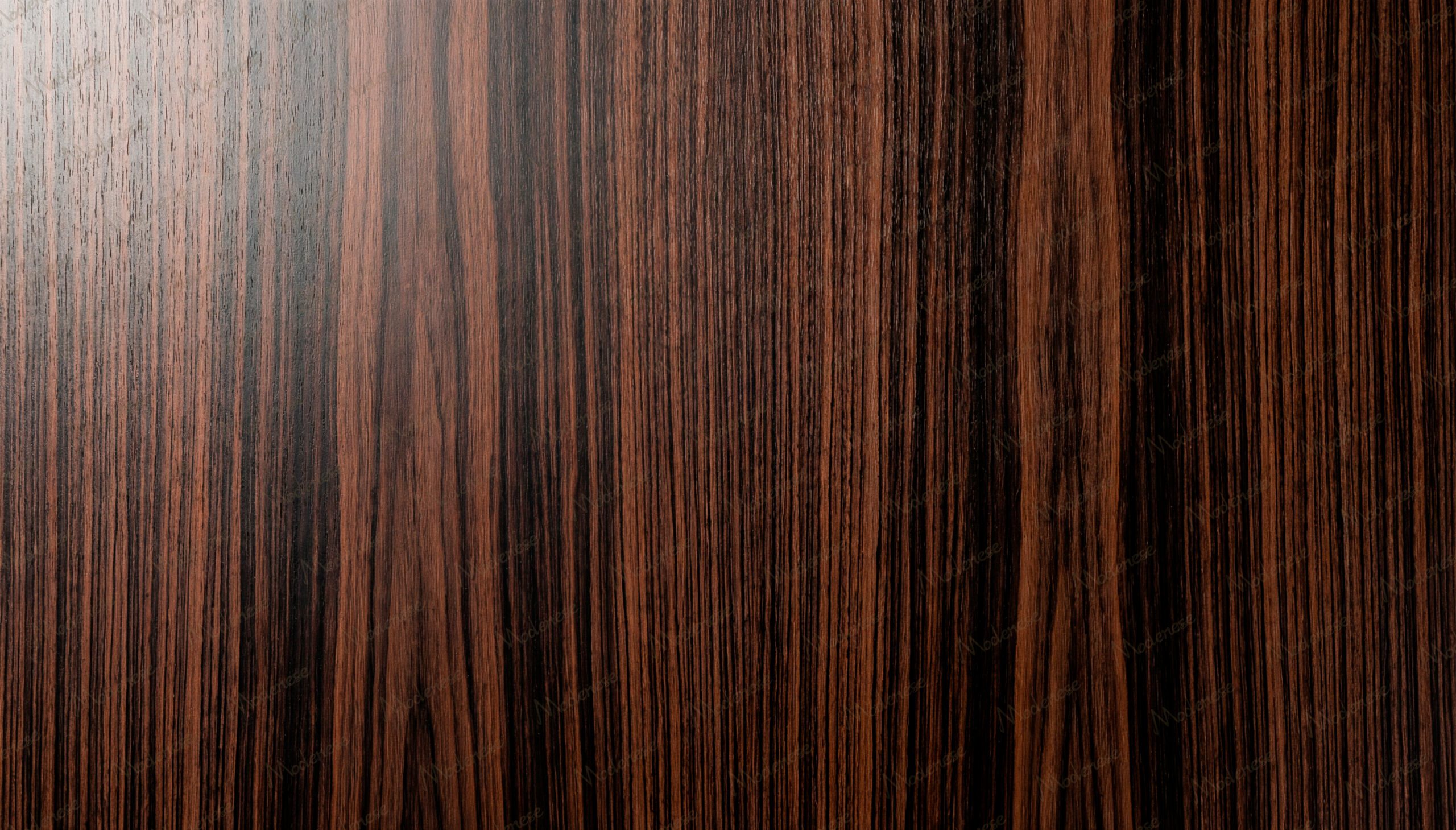
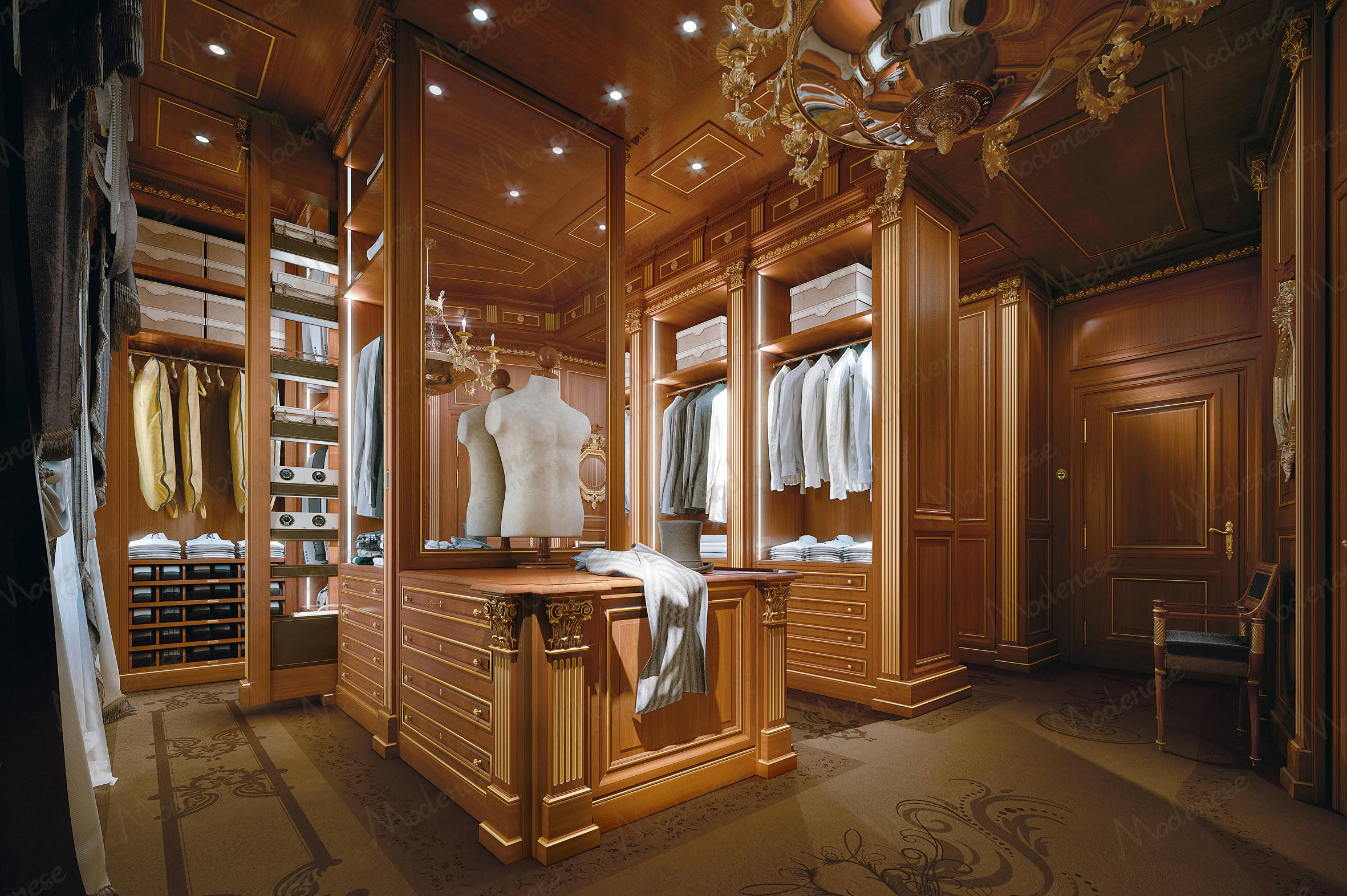
Solid wood panels (18-22mm European oak, walnut, or cherry) offer the highest durability for visible surfaces that take direct contact — door fronts, drawer faces, and exposed side panels. Solid wood absorbs minor impact without chipping, develops a patina that improves with age, and can be refinished by sanding and recoating when surface wear becomes visible. The trade-off is movement: a 600mm-wide solid walnut panel expands and contracts up to 4mm across the grain with seasonal humidity shifts. Panel construction must accommodate this — floating panel frames or expansion slots at fixed points.
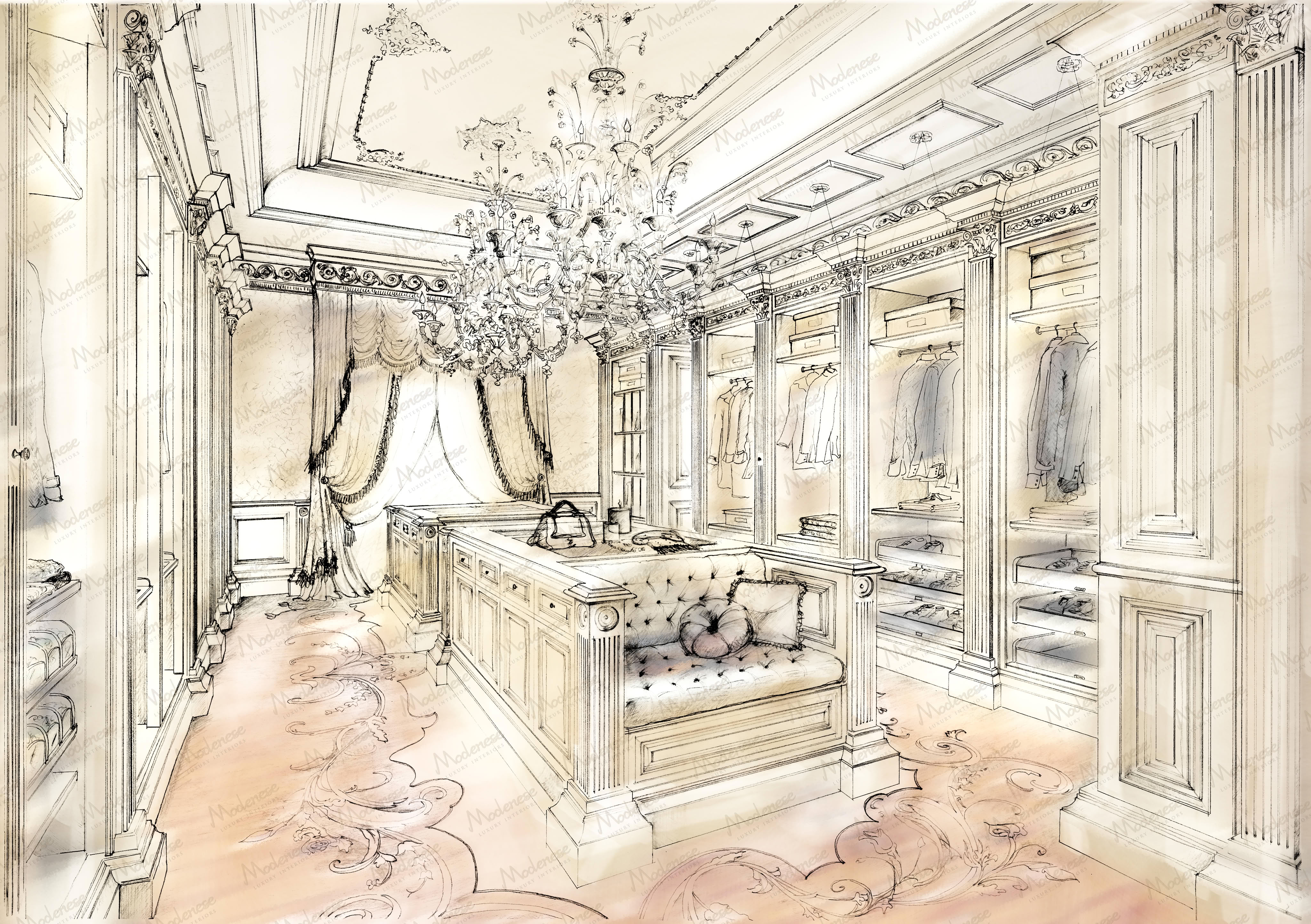
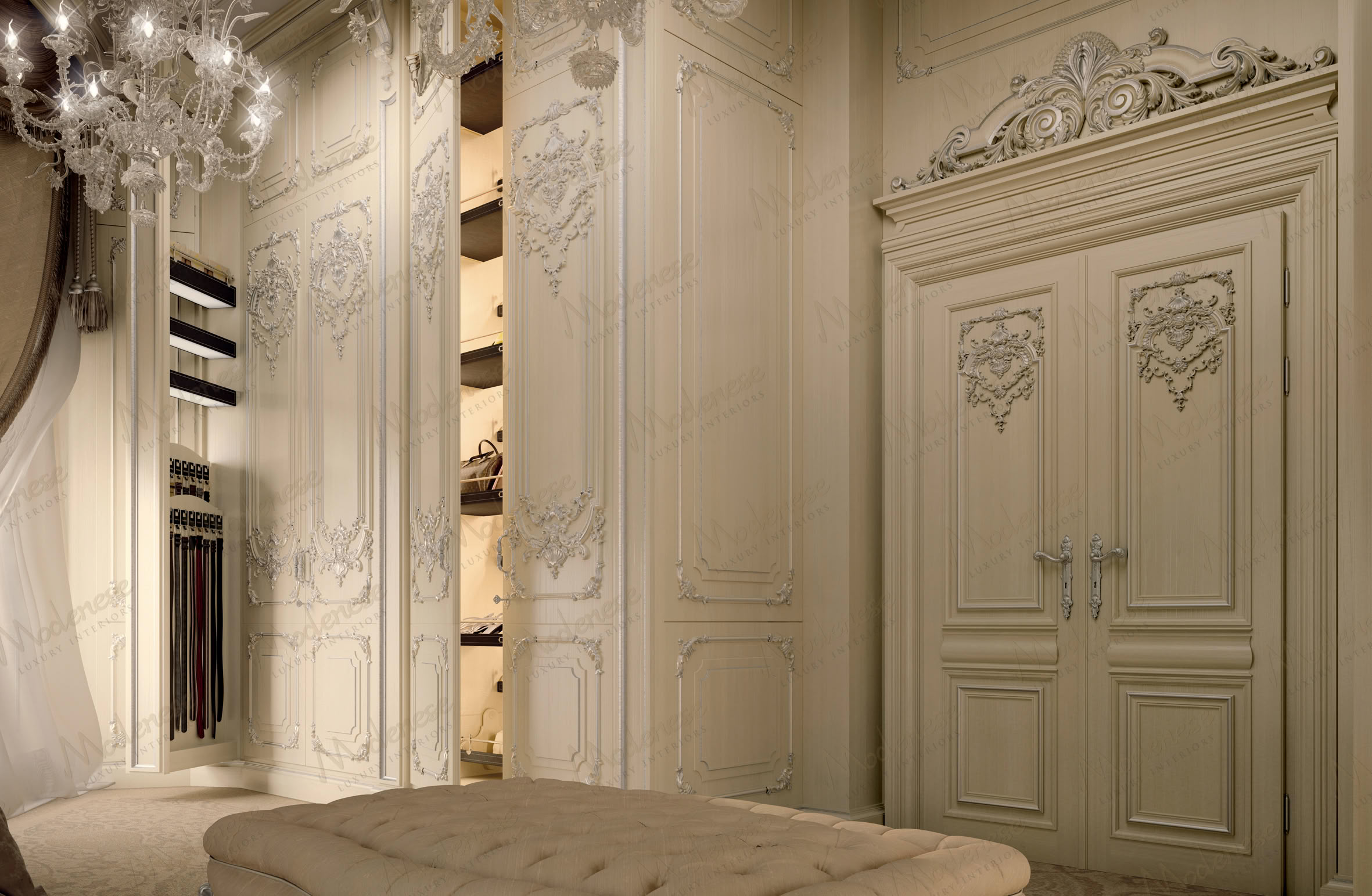
Veneered MDF (moisture-resistant grade, 18mm) provides dimensional stability that solid wood cannot match. A real wood veneer (0.6mm thickness minimum for durability) bonded to MR-MDF gives the visual warmth of natural wood with zero seasonal movement. For interior structural panels — shelf boards, carcase sides, fixed partitions — veneered MDF is the rational choice. A neoclassic wood closet typically uses solid wood for doors and decorative elements, with veneered MDF for the structural framework behind them.
Lacquered surfaces (polyurethane over MDF) suit contemporary closet designs where clean, uniform color is the goal. Two-component polyurethane lacquer applied in 4-5 coats with intermediate sanding produces a surface that resists fingerprints, scratches, and UV yellowing. Avoid polyester lacquer for closet interiors — it achieves a higher gloss but is more brittle and chips more readily on edges that see daily contact.
Wood Species for Specific Functions
Cedar and Camphor for Moth Resistance
Eastern red cedar (Juniperus virginiana) releases volatile oils — primarily cedrol and cedrene — that repel clothes moths (Tineola bisselliella) and kill newly hatched larvae. The effect is strongest in enclosed compartments where oil concentration stays high. Cedar planking on the back wall and floor of a sealed coat compartment is the most effective placement. The planking should be unfinished (no lacquer or sealant) to allow oil emission, and lightly sanded every 18-24 months to refresh the surface when the scent fades.
Camphor wood (Cinnamomum camphora) serves the same function with a different scent profile. It is more commonly used in East Asian closet construction and is available in Europe primarily as imported planking. Both species are effective; the choice is usually made on scent preference.
Structural Species
For shelf boards that bear continuous load, European oak (Quercus robur) at 22mm thickness supports 35kg across a 900mm unsupported span without measurable deflection over 10 years. Walnut is slightly softer (Janka hardness 1010 lbf vs oak’s 1360 lbf) and suits drawer faces and decorative panels better than high-load shelves. Cherry (Janka 950 lbf) darkens significantly with light exposure — attractive on door fronts, problematic on shelves where items block light unevenly, creating ghost patterns.
Drawer Slide Mechanisms
Three systems dominate the high-end closet market:
Blum Tandembox Antaro — full extension, soft-close, rated for 30kg (standard) or 65kg (heavy-duty variant). The integrated damping system (Blumotion) decelerates the drawer over the final 40mm of travel. Cycle testing: 80,000 cycles without measurable degradation. The steel sides of the Tandembox system are visible when the drawer opens, which works with modern aesthetic but requires a wooden inner drawer box for traditional classic designs.
Hettich ArciTech — similar full extension and load rating. Distinguishing feature: the drawer side height is adjustable after installation (from 94mm to 186mm) using a click mechanism, which allows field adjustment without disassembly. The Silent System damping is comparable to Blumotion. Cycle testing: 80,000 cycles.
Grass Nova Pro Scala — the thinnest side profile (13mm), which maximizes internal drawer width in standard carcase openings. Soft-close is integrated. Load rating: 40kg in the standard version. Preferred when interior drawer width is constrained and every millimeter counts — for instance, in closets retrofitted into rooms with non-standard dimensions.
All three systems use similar concealed undermount runners. The selection between them often comes down to availability of matching internal organizer systems (cutlery-style dividers, jewelry inserts, watch winders) that clip directly into each manufacturer’s proprietary drawer system.
Interior Linings: What Touches the Garments
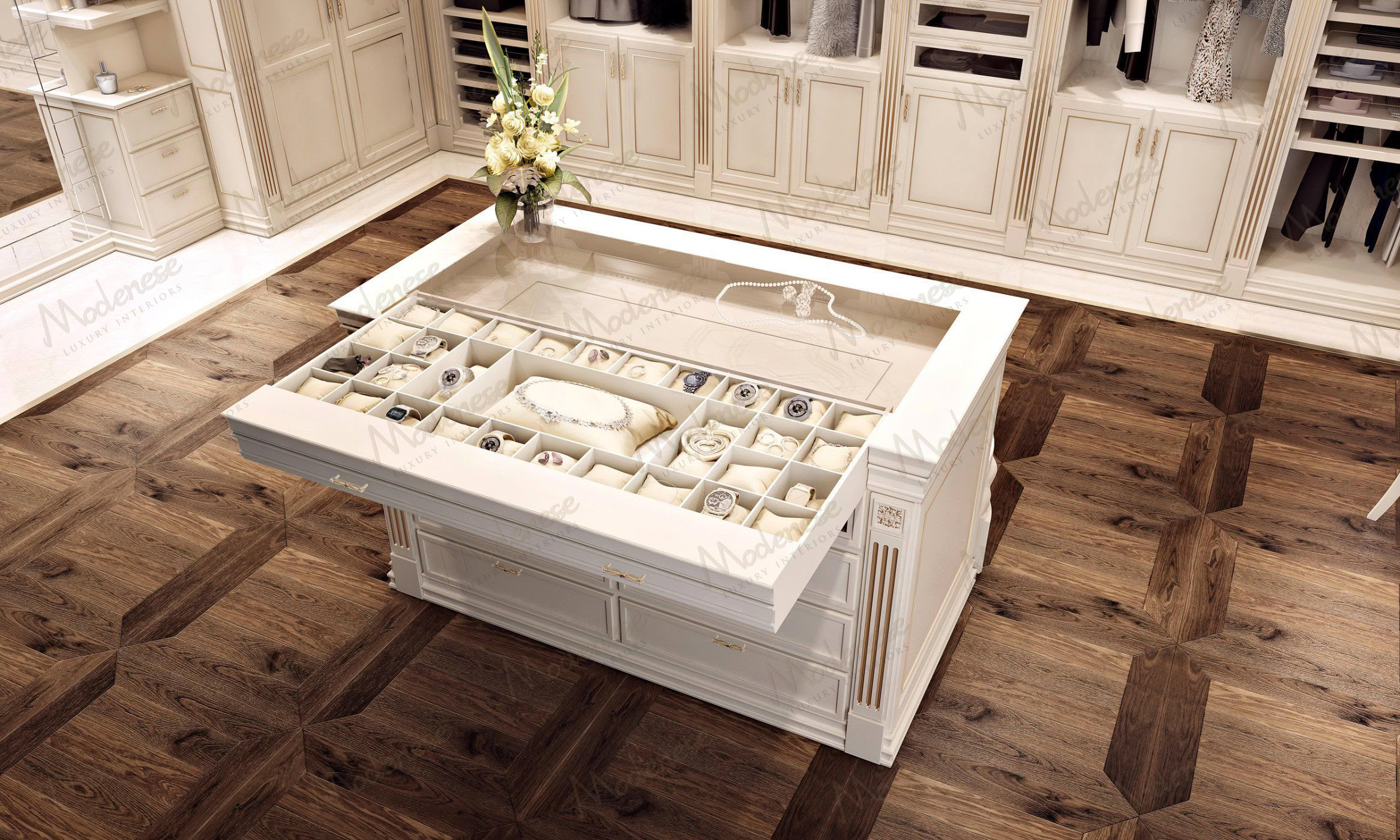
Drawer inserts for jewelry, watches, and accessories need a lining that prevents scratching, absorbs shock, and resists compression set (permanent denting from objects resting in one position).
Leather (full-grain, vegetable-tanned) is the benchmark material. Applied over 3mm closed-cell foam, it cushions items while resisting permanent compression. It develops a patina from use. Cost: approximately 280-350 EUR per square meter of finished insert. Suitable for baroque silver closets and other classically styled interiors where leather’s warm appearance matches the design language.
Ultrasuede (microfiber synthetic) provides equal scratch protection at roughly 60% of the cost. It is more stain-resistant than leather and available in a wider color range. It does not develop a patina — it looks the same on day one as on day 3,000. Preferred for deluxe modern closets where uniform appearance is the goal.
Flocked velvet (nylon flock on adhesive base) is the budget option. It works adequately for the first 3-5 years but compresses permanently under heavy items and is difficult to clean when dust accumulates in the fibers. Not recommended for closets intended to last 30 years.
Glass Shelves: Tempered vs Laminated
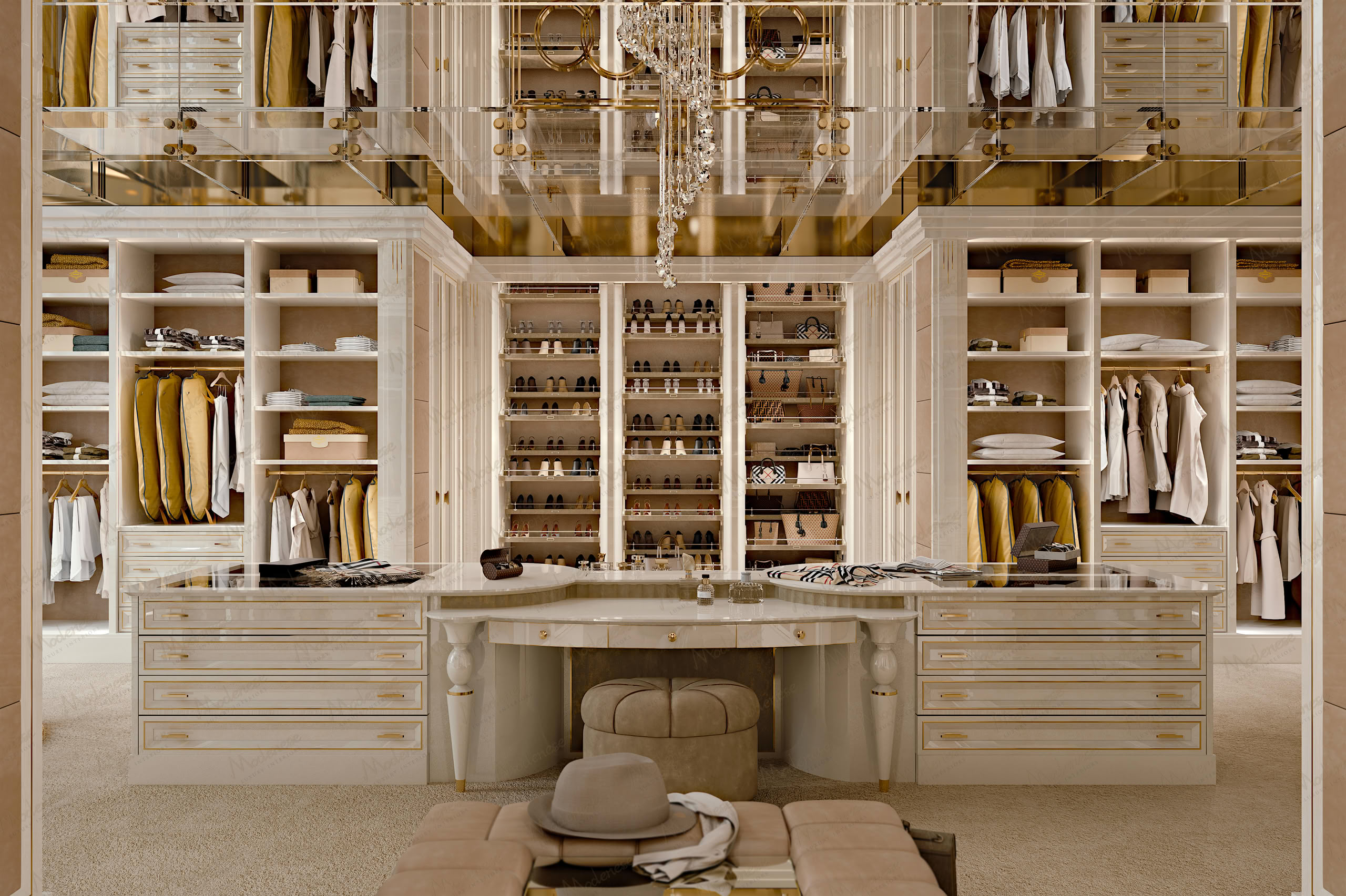
Glass shelves for shoe displays and accessory sections should be 10mm tempered glass minimum. Tempered glass shatters into small granules rather than shards on impact — a safety consideration when shelves are at head height. Load capacity: a 10mm tempered glass shelf spanning 800mm supports approximately 25kg distributed evenly.
Laminated glass (two 5mm layers bonded with PVB interlayer) holds together when cracked rather than granulating. It is heavier and marginally more expensive but provides a higher safety margin in installations where shelves are above head height.
Edge-lit glass shelves use a strip of LEDs embedded in the shelf edge, with the light transmitting through the glass via total internal reflection and exiting through etched or frosted areas on the shelf surface — as detailed in our guide to bespoke wardrobe lighting design. Back-lit shelves mount LEDs behind the shelf against the closet back panel, illuminating objects from behind. Edge-lit creates a floating glow effect; back-lit provides more functional illumination of the objects on the shelf.
Hardware Finishes That Last
Handles, hooks, hanging rods, and pull knobs are the most touched surfaces in a closet. The finish must resist tarnishing, fingerprint corrosion (from skin oils and salts), and abrasion from rings and bracelets.
PVD (Physical Vapor Deposition) coating bonds a thin ceramic-metallic layer to the base metal at the atomic level. PVD-coated hardware in brushed brass or satin nickel finish maintains its appearance for 15-20 years under normal use. It passes 200+ hours of salt spray testing (ASTM B117) without visible degradation. PVD is the standard recommendation for any luxury closet hardware.
Electroplated finishes (chrome, nickel, gold plate) are less durable. Standard electroplating passes 24-48 hours of salt spray testing. High-quality multi-layer electroplating (copper-nickel-chrome stack) extends this to 96 hours. Electroplated hardware shows wear within 5-8 years in daily-use applications — the plating thins on edges and high-contact points, revealing the base metal beneath.
The material decisions covered here interact directly with the structural choices outlined in our comparison of modular versus fixed wardrobe construction — where panel substrate selection affects connection hardware options and long-term structural integrity. Similar material engineering principles apply in Italian kitchen cabinetry, where the same wood species and finishing techniques serve different functional demands, and in solid wood kitchen construction specifically.